 Student Motivation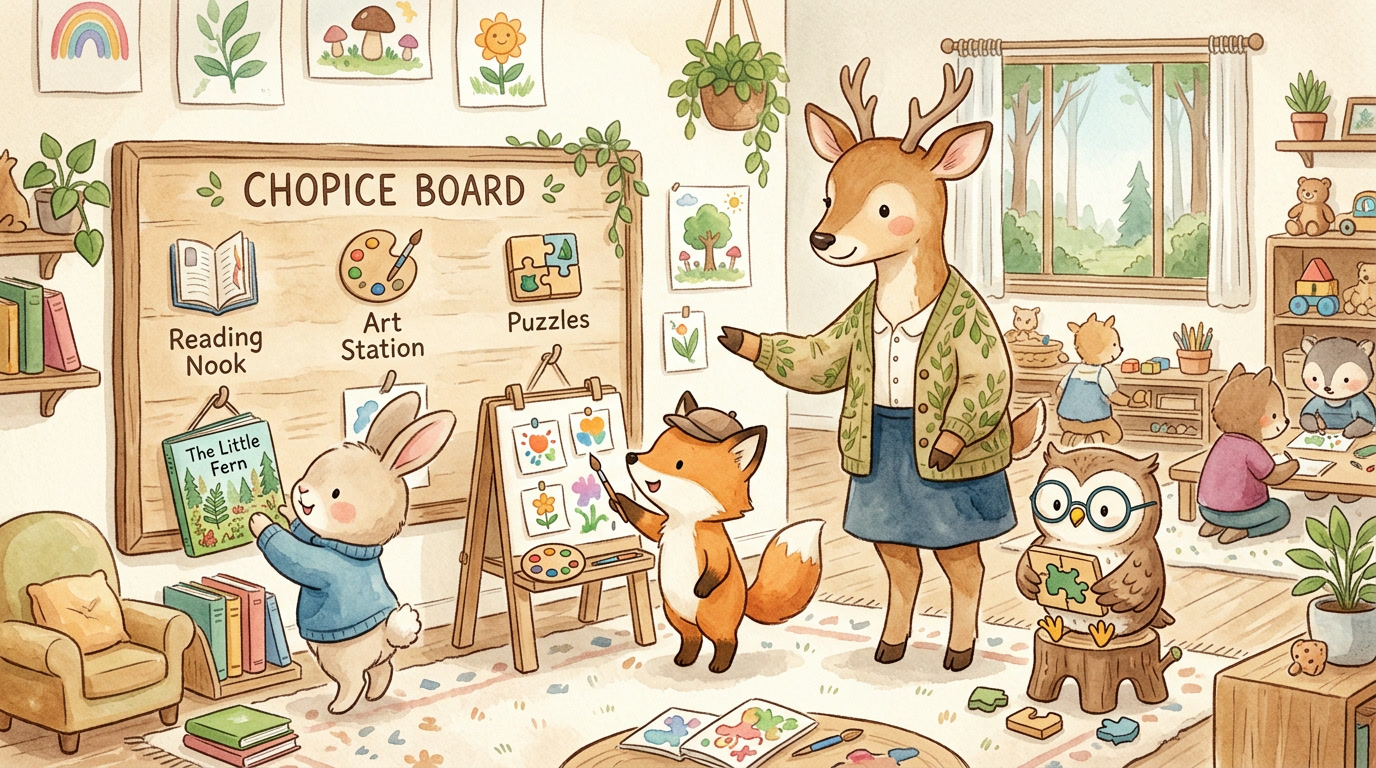
Think about the last time you couldn't wait to get started on something — a recipe, a project, a book you picked yourself. Nobody had to bribe you. You chose it, so you wanted to do it. That feeling has a name in motivation research, and it turns out to be one of the most powerful levers a teacher has. It's called autonomy, and you don't need a new reward system to use it. You just need to hand students a little more of the steering wheel.
The need behind the motivation
Under the hood of Self-Determination Theory — the research framework behind much of what we know about motivation — sit three basic psychological needs that every person is wired to seek: autonomy (I have a say), competence (I can do this), and relatedness (I belong here). When a classroom meets those needs, students move toward self-determined motivation: they act out of genuine interest and personal value, not just to chase a prize or dodge a consequence.
This is the same story we tell in intrinsic vs. extrinsic motivation: rewards can start a behavior, but they don't make it stick. What makes motivation last is a student feeling ownership over the work. Autonomy is how you build that ownership.
Autonomy support isn't a free-for-all
Here's the misconception worth clearing up first: giving students autonomy is not letting them do whatever they want. Autonomy support and classroom structure aren't opposites — the strongest teaching pairs them.
Picture two teachers who both assign a book report. One says, "Do it my way, because I said so." The other says, "You'll each share what you read — you can write a review, record a short talk, or make a poster. Here's why it matters: explaining a story helps you understand it more deeply." Same academic goal. Same high expectations. But the second version gives students a voice inside the structure. That's autonomy support: you set the destination and the guardrails, and students choose the path within them.
What autonomy-supportive teaching actually looks like
Researchers Johnmarshall Reeve and Sung Hyeon Cheon describe autonomy-supportive teaching as a specific, teachable set of behaviors. The good news buried in that word teachable: this isn't a personality you're born with. It's a skill you can practice. A few of the moves:
Offer bounded choice
You don't have to hand over the whole curriculum. Small choices carry most of the weight:
- Which: "Pick any five of these ten problems."
- Order: "Start with reading or writing — your call."
- How: "Show me you understand this any way you like — diagram, paragraph, or explain it out loud."
Two or three teacher-approved options keep the room calm while still giving students genuine ownership.
Explain the why
When a task has an unavoidable, non-negotiable part, don't hide the reason — name it. "We're revising this a second time because good writing is rewriting." A brief rationale turns a demand into an invitation and helps students internalize the value of the work.
Acknowledge how it feels
Autonomy support includes saying "I know this one's tricky and a little frustrating" instead of "It's not that hard." Naming the feeling doesn't lower the bar; it tells students their experience is respected, which keeps them in the game.
Use inviting language
Small wording shifts matter. "You might try…" and "When you're ready…" invite; "You have to" and "Because I said so" pressure. Non-controlling language signals that the effort is coming from the student, not being squeezed out of them.
Why it's worth the effort
This isn't a soft, feel-good add-on. In a meta-analysis of 144 samples and more than 79,000 students, Julien Bureau and colleagues found that teacher autonomy support predicts students' self-determined motivation more strongly than parental autonomy support does — meaning what you do in your room genuinely moves the needle. Across the research, autonomy-supportive teaching is linked to higher engagement, more effort, better skill development, and stronger achievement.
Notice, too, that the meta-analysis ranked competence as the single most important need for motivation, with autonomy close behind. That's a helpful reminder: choice works best when students also feel capable. Pair a little autonomy with tasks pitched at the right challenge level and specific, process-focused praise, and you're feeding two needs at once.
Start small this week
You don't need to redesign anything. Pick one already-planned lesson and add a single choice — which problems, what order, or how to show the work. Explain one why you'd normally leave unspoken. That's it. Autonomy compounds: every small handoff of ownership teaches students that school is something they do, not something that happens to them.
For more on building drive that outlasts any sticker chart, see how to motivate students and growth mindset in the classroom — or head back to Chou Chou Teach to build the kind of recognition system that supports autonomy instead of replacing it.
References
- Bureau, J. S., Howard, J. L., Chong, J. X. Y., & Guay, F. (2021). Pathways to Student Motivation: A Meta-Analysis of Antecedents of Autonomous and Controlled Motivations. Review of Educational Research, 92(1), 46–72.
- Reeve, J., & Cheon, S. H. (2021). Autonomy-Supportive Teaching: Its Malleability, Benefits, and Potential to Improve Educational Practice. Educational Psychologist, 56(1), 54–77.
- Ryan, R. M., & Deci, E. L. (2000). Self-Determination Theory and the Facilitation of Intrinsic Motivation, Social Development, and Well-Being. American Psychologist, 55(1), 68–78.
Frequently asked questions
What is student autonomy in the classroom?
How does giving students choice increase motivation?
What is autonomy-supportive teaching?
Doesn't giving students choice lead to chaos?
Is autonomy support something teachers can actually learn?

Bec
Teacher & Chou Chou Educator
Bec is a fifth grade teacher who lives and breathes positive classrooms. She writes the Chou Chou Learn library to help fellow teachers catch their kids being good.