 Classroom Management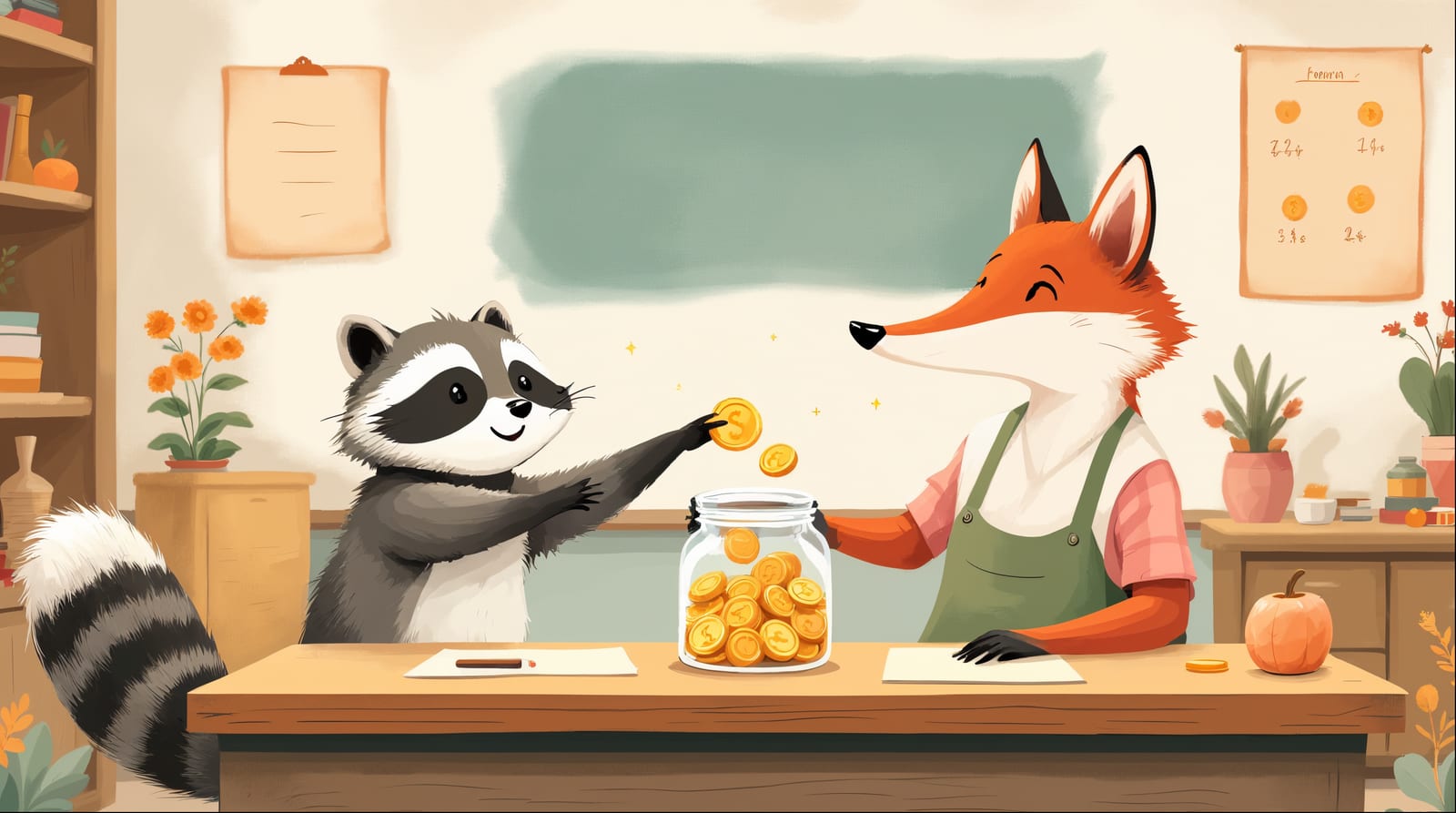
A classroom token economy is a behavior system where students earn tokens — points, tickets, stamps — for showing the behaviors you want, then exchange those tokens for rewards. It's one of the most studied tools in classroom management, rooted in operant conditioning, and it works when it's specific, consistent, and faded over time. This guide walks through what a token economy is, its honest pros and cons, and a six-step setup that motivates students without sliding into bribery.
What is a token economy?
At its core, a token economy has three parts:
- A target behavior you want to see more of (e.g., raising a hand, returning homework, helping a peer).
- A token — something countable the student earns immediately when they do it.
- A backup reward — what the accumulated tokens can be exchanged for.
The token itself has no value; it's a stand-in for the reward, the same way a dollar bill is just paper that stands in for what it buys. That's the clever part: the token lets you reinforce behavior the instant it happens, even if the actual reward comes later.
This is a direct application of operant conditioning — the principle, established by B. F. Skinner, that behavior followed by reinforcement tends to increase. The first formal token economies were developed by Teodoro Ayllon and Nathan Azrin in the early 1960s, who used token systems to support positive behavior in clinical settings. Classrooms borrowed the model, and it's been a staple of behavior management ever since.
What are the pros and cons?
Token economies are popular for good reasons, but they're not magic. Here's an honest ledger.
| Pros | Cons |
|---|---|
| Make reinforcement immediate, even when rewards come later | Can drift toward bribery if run carelessly |
| Clear and concrete — students know exactly what earns a token | Risk of undermining intrinsic motivation if overused |
| Work for a whole class at once, not just one student | Require consistency — sporadic delivery breaks the system |
| Give you data on which behaviors are improving | Material rewards can get expensive and competitive |
| Flexible — you control the behaviors and the exchange rate | Hard to fade if students become dependent on tokens |
The two biggest worries — bribery and intrinsic motivation — are real, and worth addressing head-on. The research from Edward Deci and Richard Ryan on self-determination theory warns that controlling, tangible rewards can crowd out a student's natural interest in a task. The fix isn't to avoid tokens entirely; it's to design the system so it builds toward independence rather than dependence. We unpack this tension in our guide to intrinsic vs. extrinsic motivation — worth reading before you launch.
How do I set up a token economy? (Step by step)
Step 1: Define your target behaviors
Start by naming a small number of specific, observable, positively stated behaviors. "Be a good student" is too vague to reinforce; "raise your hand before speaking" and "help a classmate who's stuck" are concrete. Aim for three to five so students (and you) can keep them straight. Positively stated matters — you're reinforcing what to do, not punishing what not to do.
Step 2: Choose your tokens
Your token needs to be easy to give instantly and hard to lose or fake. Options include physical tickets, stamps, tally marks, or — increasingly common — digital points in an app. Digital points have a real edge here: they can't fall out of a backpack, can't be counterfeited, and tally automatically. (In Chou Chou Teach, points only ever go up, which keeps the system focused on what students earn rather than what they lose.)
Step 3: Set the exchange and backup rewards
Decide what tokens buy and at what price. A few principles:
- Mix small and large. Some cheap rewards students can afford often, plus a bigger occasional one, keeps everyone motivated.
- Favor privileges over prizes. Extra read-aloud time, choosing the line order, a "teacher's helper" role, or class music often beat material prizes — they cost nothing and feel special.
- Keep prices reasonable. If the reward is too expensive, students give up; too cheap, and the token loses meaning.
Step 4: Teach the system explicitly
Don't assume students will infer the rules. Teach the token economy like a lesson: show exactly which behaviors earn tokens, demonstrate earning one, and walk through an exchange. Post the behaviors and the reward menu where everyone can see them. Clarity up front prevents arguments later.
Step 5: Deliver tokens consistently and immediately
This is where systems live or die. Award the token the moment the behavior happens, and pair it with specific praise — "You helped Maya without being asked, that's a point." The praise tells the student why they earned it, which is what builds the habit. (Jere Brophy's classic work on teacher praise found that praise only works when it's specific, sincere, and contingent on real behavior — the same rules apply to tokens.) Inconsistency is the number one killer of token economies; if you reinforce a behavior on Monday and ignore it on Tuesday, the system stops meaning anything.
Step 6: Fade the system over time
A good token economy is a scaffold, not a permanent fixture. Once behaviors are established, gradually fade it:
- Stretch the ratio — require more of the behavior, or a longer stretch of time, to earn a token.
- Lean on praise — let specific verbal acknowledgment carry more of the weight.
- Shift the rewards toward social and autonomy-based ones (choice, responsibility, recognition) rather than tangible prizes.
Fading is what turns "I behave to get a point" into "I behave because it's how our class works" — the bridge from extrinsic to intrinsic motivation. Skipping this step is what makes a token economy feel like bribery; doing it well is what makes it a teaching tool.
Bribery or reinforcement?
The line is simpler than it sounds. Bribery is offered before and during misbehavior to make it stop ("If you stop yelling, you can have a treat") — it rewards the wrong thing. Reinforcement comes after a desired behavior to make it more likely next time. A token economy, run the way described above, is squarely reinforcement: students earn tokens by doing the right thing, not by stopping the wrong thing.
Putting it together
A token economy doesn't have to be elaborate to work — it has to be specific, consistent, and built to fade. Start with a few clear behaviors, a simple token, a modest reward menu, and the discipline to deliver every single time. Then loosen your grip as good habits take hold.
This is the philosophy behind Chou Chou Teach: a positive-only points app where points never go down, students are just a first name and an avatar (no logins, no last names), and the focus stays on what kids are doing right. Pair it with our reads on intrinsic vs. extrinsic motivation and positive reinforcement in the classroom to build a system that lasts.
References
- Ayllon, T., & Azrin, N. H. (1968). The Token Economy: A Motivational System for Therapy and Rehabilitation. Appleton-Century-Crofts.
- Skinner, B. F. (1953). Science and Human Behavior. Macmillan.
- Brophy, J. (1981). Teacher praise: A functional analysis. Review of Educational Research, 51(1), 5–32.
- Deci, E. L., & Ryan, R. M. (1985). Intrinsic Motivation and Self-Determination in Human Behavior. Plenum.
Frequently asked questions
What is a classroom token economy?
Do token economies work?
Isn't a token economy just bribery?
What can students use as tokens?
How do I move students from rewards to intrinsic motivation?

Bec
Teacher & Chou Chou Educator
Bec is a fifth grade teacher who lives and breathes positive classrooms. She writes the Chou Chou Learn library to help fellow teachers catch their kids being good.